

Texas is entering a new energy era 🤠⚡
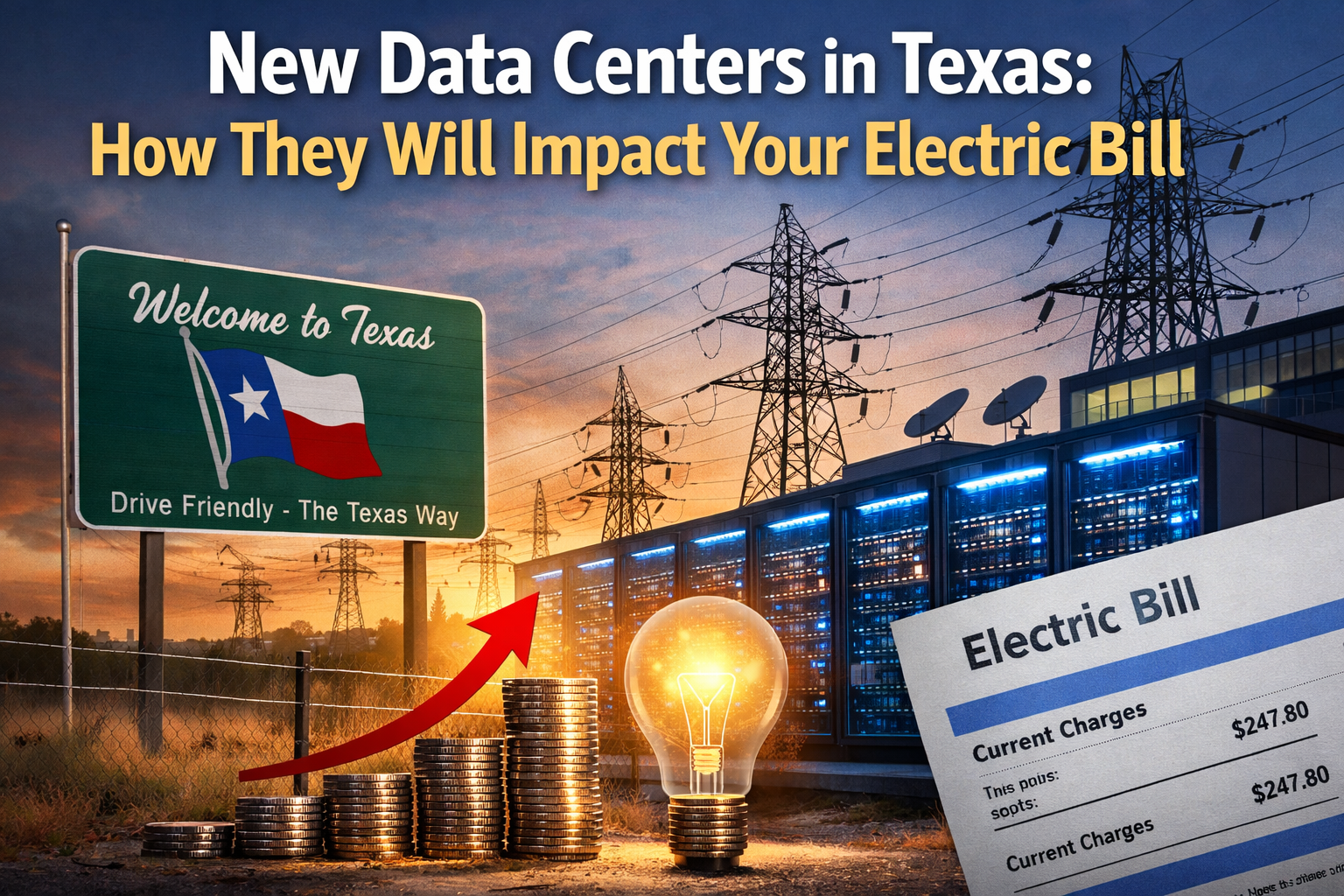
Over the next two years, dozens of massive data centers are expected to come online across the state. From AI infrastructure 🤖 to cloud computing ☁️ and digital storage facilities, Texas has become ground zero for America’s tech expansion.
But here’s the question homeowners and business owners really care about:
💡 What does this mean for my electric bill?
Let’s break it down.
🚀 Why Data Centers Are Flocking to Texas
Texas checks every box for large-scale tech development:
✅ Abundant land
✅ Business-friendly policies
✅ Competitive electricity markets (ERCOT)
✅ Rapid renewable energy growth 🌞🌬️
Solar and wind capacity have expanded quickly, making Texas attractive to companies with carbon reduction goals.
But while this is great for economic growth and job creation 💼, it creates new challenges for the power grid.
📊 The Scale of What’s Coming
Modern data centers consume enormous amounts of electricity.
A single AI-focused facility can use as much power as 50,000–100,000 homes 🏠🏠🏠.
Now multiply that across major growth areas:
📍 Dallas–Fort Worth
📍 Austin
📍 San Antonio
📍 Houston
📍 West Texas
ERCOT has already projected significant load growth over the next several years — and data centers are a major driver.
This isn’t slow, steady growth.
It’s exponential 📈.
⚙️ How Increased Demand Impacts the Texas Grid
Texas operates mostly on its own independent grid (ERCOT). That means supply and demand must stay balanced within the state.
When demand rises faster than generation and transmission capacity, three things happen:
1️⃣ Higher Wholesale Power Prices 💵
Texas electricity operates in a market system. When supply tightens — especially during summer heatwaves 🔥 — wholesale prices can spike.
Retail electric providers pass those costs through in:
• Variable-rate plans
• New fixed-rate contracts
• Renewals
2️⃣ More Grid Strain During Peak Hours ⚠️
Data centers operate 24/7 🖥️.
Unlike residential demand, they don’t drop significantly overnight. That reduces the “off-peak relief” the grid typically depends on.
During extreme summer temperatures, this constant load could amplify price volatility.
3️⃣ Infrastructure Costs 🏗️
Supporting this new demand requires major investment:
• New generation plants
• Battery storage systems 🔋
• Transmission upgrades
• Grid stabilization technology
Those costs are ultimately recovered through rates and delivery charges.
And yes — consumers share in that cost.
💰 Will Everyone’s Electric Bill Go Up?
Not automatically — but upward pressure is building.
Here’s what will determine the impact:
🔹 If Generation Keeps Pace
Texas is adding solar and battery storage at record speed 🌞🔋. If supply keeps up, pricing may stay competitive.
🔹 If Extreme Weather Hits
A 105°F August day plus record demand = price volatility 📊🔥.
🔹 Your Electric Plan Type
• Fixed-rate customers are insulated (short-term)
• Variable-rate customers are more exposed
• Businesses with demand charges may feel it first
🤖 The AI Factor: 24/7 High-Intensity Load
AI data centers consume far more power than traditional facilities.
Cooling systems alone can represent 30–40% of total facility energy use ❄️.
This isn’t just about servers.
It’s about round-the-clock cooling in Texas heat.
That changes the demand curve permanently.
🌞 The Opportunity: Renewable Energy & Energy Independence
Here’s the encouraging part.
Many large data centers are now:
• Signing long-term solar power purchase agreements
• Building co-located solar farms
• Investing in battery storage
• Exploring microgrids
Why?
Because locking in energy costs protects against volatility 📉.
And that same strategy works for homeowners and businesses.
🏠 What Texans Should Be Thinking About Right Now
Instead of waiting for rate increases, consider:
1️⃣ Locking in a competitive fixed-rate contract
2️⃣ Installing solar to offset peak pricing 🌞
3️⃣ Adding battery storage for outage & peak protection 🔋
4️⃣ Upgrading energy efficiency
Lower usage = lower exposure to rising demand.
⚖️ Could Data Centers Actually Help the Grid?
Possibly.
Some data centers participate in demand response programs — meaning they reduce load during grid emergencies.
If structured correctly, large flexible loads could help stabilize the grid instead of strain it.
But that depends on regulation, infrastructure planning, and execution over the next 24 months.
🔮 The Big Picture: Texas Is Evolving
The Texas grid isn’t collapsing.
It’s transforming.
We’re seeing:
📈 Record load forecasts
🌞 Massive renewable expansion
🔋 Rapid battery deployment
🤖 AI-driven electricity demand
🏗️ Infrastructure upgrades
The next two years will shape electricity pricing for the next decade.
❓ Are You Positioned for What’s Coming?
If demand surges and infrastructure costs rise, those who:
✔️ Produce their own power
✔️ Store their own energy
✔️ Lock in smart energy contracts
…will be in the strongest position.
Everyone else may feel it in their monthly statement.
🌊 Take Control of Your Energy Future
At Aguasol Energy, we help Texas homeowners and businesses:
• Design custom solar systems
• Install battery storage solutions
• Reduce grid dependence
• Protect against rising electricity rates
The grid is changing.
Make sure your energy strategy changes with it.
👉 Schedule your free energy consultation today at aguasolenergy.com